


By Altaf Hussain Wani
 As Yasin Malik faces the possibility of the death penalty, Kashmir’s history shows that the gallows can turn contested figures into enduring political symbols rather than bring closure to conflicts shaped by decades of violence, grievance and mistrust
In 1984, JKLF leader Maqbool Bhat was hanged in Delhi’s Tihar Jail. His execution did not close a political chapter in Kashmir. In the years that followed, Bhat became an enduring symbol for a generation of Kashmiris, while the dispute itself entered a far more violent phase.
Nearly three decades later, Afzal Guru was executed in the same prison. The Supreme Court judgment in his case famously referred to the “collective conscience of society”, a phrase that continues to provoke debate because criminal justice is supposed to rest on evidence and law, not public sentiment.
Executions acquire meanings far beyond courtrooms, particularly in unresolved political conflicts. Kashmir’s history should therefore make New Delhi extremely cautious as another prominent Kashmiri separatist, Yasin Malik, confronts proceedings that could potentially carry the ultimate penalty.
A third execution involving a figure deeply embedded in Kashmir’s separatist history may not put a full stop to anything. It could instead become the beginning of another political narrative.
The court faces an unusual situation.
 Malik maintains his innocence in the case while reportedly asking that, if convicted, he be given the maximum punishment. Such a position risks turning an ordinary judicial proceeding into a contest over martyrdom, legitimacy and political memory.
The court must refuse to participate in that contest.
If Malik is convicted, the judgment must rest solely on admissible evidence tested through due process. If he is acquitted, that decision too must flow from the record. Neither Malik’s political history nor the passions surrounding Kashmir should determine the outcome.
That sounds obvious. Yet it is precisely what makes the case such an important test.
The strength of a judicial system is demonstrated most clearly when the defendant is unpopular with powers and politically contentious. Justice becomes meaningful when courts resist pressure from the powers and the street, television studios, and defendants themselves.
The answer to political theatre is not counter-theatre. It is painstakingly ordinary justice.
Mandela Comparison
Malik has invoked Nelson Mandela while describing the personal costs of political struggle, including the near collapse of his marriage.
Mandela’s life may not simply be transplanted onto Kashmir, yet there is a lesson here for the Indian state.
Governments cannot prevent political prisoners or leaders demanding the right to self-determination from presenting themselves through historical analogies. They can, however, deny such comparisons their persuasive power by ensuring scrupulous due process.
Every procedural shortcut, prejudicial leak, or television verdict delivered before a court reaches its judgment strengthens the argument that the proceeding is political rather than judicial.
A confident state does not need to suppress uncomfortable comparisons. It disproves them through its conduct.
Lost amid the politics is the family of the Kashmiri Pandit nurse Sarla Bhat.
Her family did not choose to become part of a geopolitical argument. It wanted an investigation, accountability and justice after her killing in 1990.
Whatever one’s opinion of Malik or the movement, the extraordinary delay in bringing old cases to a conclusion demands explanation.
Had such cases been properly investigated and tried in the early 1990s, judgments could have been delivered, challenged on appeal, and eventually become part of the settled judicial record.
Instead, families have spent decades waiting.
That delay harms victims most. It also damages the credibility of the justice system because proceedings revived decades later inevitably attract questions about timing and political purpose.
Justice delayed for 35 years cannot suddenly become more just merely because the machinery of prosecution has begun moving again. The state must explain why it took so long and demonstrate that the present process is driven by evidence rather than political convenience.
The victims deserve that much. So does the accused.
India should approach the case with the confidence for the sake of credibility of its own institutions.
First, the proceedings should be completed transparently and without unnecessary delay. The court’s reasoning should speak through the judgment rather than through political commentary outside it.
Second, criminal liability must be separated from ideology. Malik should be judged for acts that prosecutors can prove according to law, not for advocating an idea Delhi opposes.
Third, policymakers should consider the wider consequences for conflict resolution.
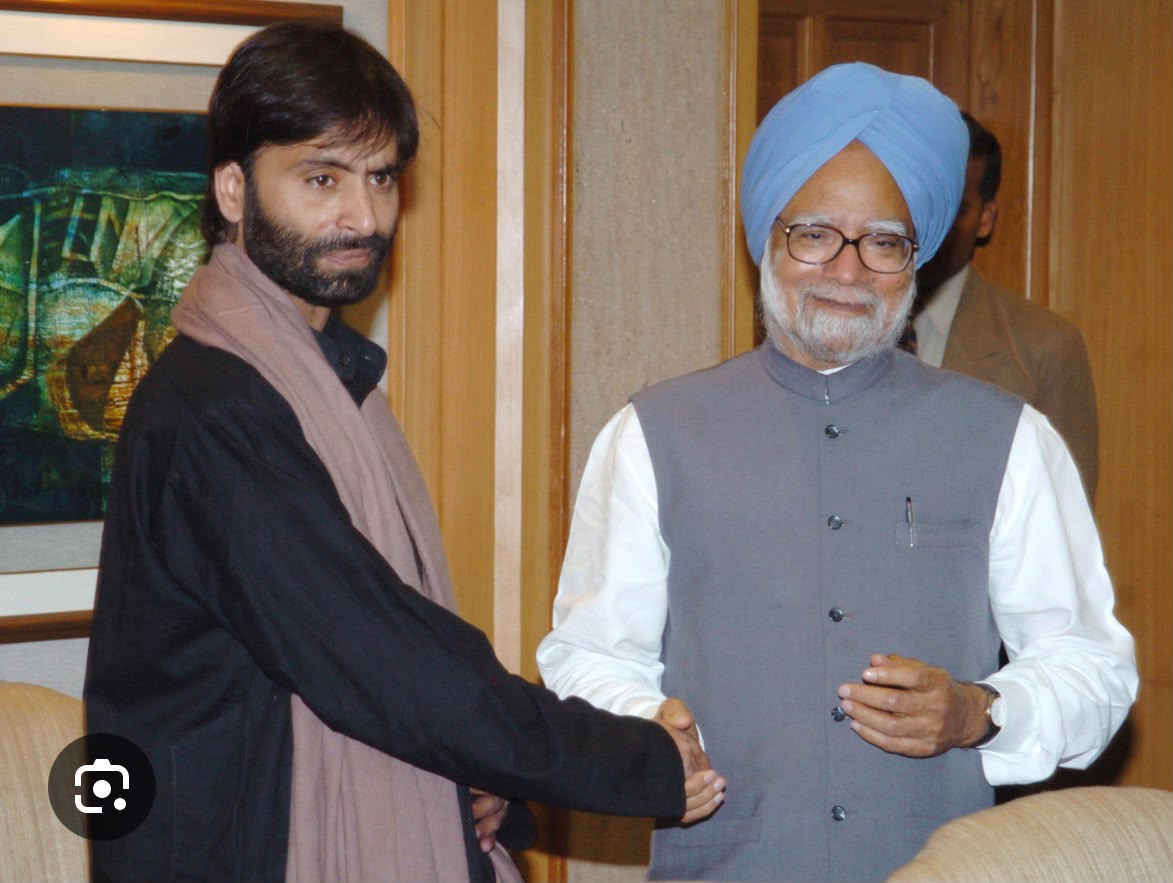
Malik’s trajectory is unusual. He moved from militancy to publicly renouncing armed struggle and subsequently participated in political engagement. He met Indian leaders and became part of conversations surrounding attempts to find a political opening in Kashmir.
That history does not confer immunity from prosecution for an alleged crime. No peace process can erase the rights of victims or place former militants beyond the reach of law.
But states must also consider the signals they send to people they may someday need across a negotiating table.
Peace processes depend partly on confidence that abandoning violence and entering dialogue creates political space. If former interlocutors subsequently believe engagement itself offers no meaningful path, future militants may conclude that laying down arms carries risks without rewards.
That would be a dangerous lesson.
Beyond Verdict
Malik appears determined to write his own political epitaph. His message is that he will not contest his case or plead for mercy, and that does not mean accepting the guilt.
New Delhi should resist answering symbolism with symbolism.
Its objective should be far less dramatic: to ensure that the eventual record shows that the allegations were examined fairly, evidence was tested, the defence was heard and the judgment was reached without regard to political pressure.
Courts decide guilt. History decides what a verdict ultimately comes to represent.
Kashmir demonstrates the distinction painfully. Maqbool Bhat’s execution did not erase his politics. Afzal Guru’s hanging did not end the arguments surrounding his case. Both became reference points in a conflict that survived them.
The same risk surrounds Yasin Malik.
If the state ultimately seeks the noose, it should first ask what the noose has achieved before.
An execution may end a life. It rarely ends an idea. In a conflict sustained as much by memory as by territory, it can give that idea another anniversary, another symbol and another generation of listeners.
The wiser legacy would be less dramatic but more durable: justice demonstrably done, victims acknowledged, evidence tested and a verdict capable of surviving political change.
In Kashmir, where history has repeatedly been written through graves and gallows, sometimes the most courageous act of a state is to refuse to create another martyr.
The writer is chairman of the Kashmir Institute of International Relations. He can be reached on X at @sultan1913 and at saleeemwani@hotmail.com.
